
Campbell County Recent Arrest Sources
Public custody in Campbell County starts at one desk. The Campbell County Detention Center Current Inmates roster lists everyone held in local jail right now. CCDC books arrests for every agency in Campbell County, from city departments to Northern Kentucky University Police and Kentucky State Police. The arresting officer writes the incident report. CCDC, run by the elected jailer rather than the sheriff, creates the booking record. That division is why one name can involve several offices.
Campbell County publishes no 24-hour booking feed. No weekly arrest blotter exists either. The sheriff posts monthly activity reports, though those are not person-by-person bookings. City police pages offer news or request forms instead of a daily roster. Confirm each name with CCDC or the arresting agency.
| View | True scope | Best use |
|---|---|---|
| CCDC Current Inmates | Current public jail custody | Confirm an official roster listing |
| 24 Hour Arrests | Same-day secondary view | Identify a recent date or agency |
| Arrest Log | Rolling and dated private archives | Look beyond the roster window |
Search Campbell County Arrest Custody
JailTracker shows current inmates only. It is a custody tool, not an arrest archive. The official CCDC FAQ directs name searches to Current Inmates and asks users to call when a known inmate is missing. Bond appears under the person's picture. CCDC states no fixed update hour or rule for how long a released entry stays visible.
| Roster item | What it can show |
|---|---|
| Name | The identity attached to current custody |
| Roster presence | Appearance in the public current-custody listing |
| Picture | A booking image in the current workflow |
| Bond | A release condition or amount, not a sentence |
| Charged offenses | Intake charges that may change in court |
Open the live roster, type the name, compare the identities returned, and open the likely record. Read custody, charge, bond, and photo details in context. A fresh booking may still be processing. If it stays absent, call CCDC at 859-431-4611. A negative result can also mean release, transfer, a restricted category, or a spelling mismatch.
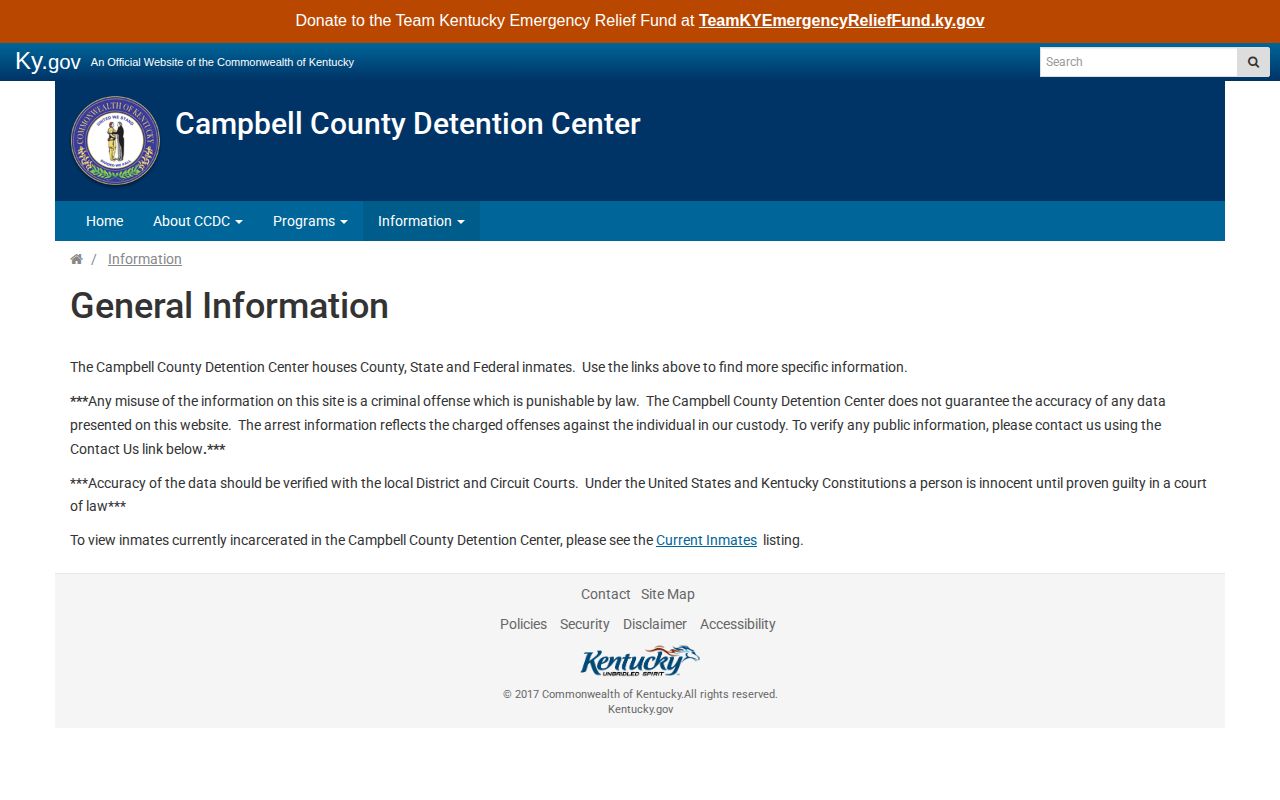
The CCDC information page explains charged offenses in the official source.
Campbell County offers no booking app. The web roster is the documented tool. Kentucky VINE adds custody alerts. Registration steps and limits are in VINELink Check. The county advises checking roster data against District or Circuit Court records. CCDC withholds federal and immigration detainee information from ordinary local inquiry. Juvenile and sealed records may also be withheld. A missing name on JailTracker is never proof that no custody exists.
Note: Incident time, jail intake time, and publication time are separate events, and Campbell County promises no fixed interval between them.
Who Holds Campbell Arrest Records
Three keepers split every Campbell County arrest record. The police department holds the incident report. CCDC keeps the booking and inmate file. The Campbell Circuit Court Clerk takes over once charges are filed, so route each request by record type rather than by name alone.
- Booking
- The jail intake event that records identity, charges, property, custody, and related details.
- Arraignment
- The first court stage at which charges and rights are stated and a plea is entered.
- Bond
- A condition or amount tied to pretrial release, not punishment or guilt.
- Disposition
- The court’s outcome, such as dismissal, plea, acquittal, or judgment.
- Expungement
- A court process affecting eligible records under Kentucky law.
CCDC's countywide booking role has old roots. The CCDC history page dates it to 1796. A 2016 expansion cost $7.53 million, adding 107 jail beds and 36 isolation beds. Those figures describe growth, not today's capacity, yet they show why one jail handles bookings from every agency in Campbell County.
Where Campbell Arrests Get Published
Official channels should lead any Campbell County arrest search. News pages and private archives answer narrower questions. They may lag, omit entries, or keep a record alive after release. LINK nky, NKyTribune, and WCPO cover notable investigations and court developments, but none serves as a full arrest ledger for Campbell County.
| Channel | Photo | Status and use |
|---|---|---|
| CCDC JailTracker | May display | Official current public custody |
| CCDC records custodian | Request if maintained | Official underlying record |
| Kentucky DOC KOOL | Most profiles, not all | Official state custody or supervision |
| Kentucky courts | Not a photo locator | Official case and disposition |
| Local news | Story-dependent | Selected events, not a roster |
| Private booking sites | Often | Unofficial discovery only |
Private sites also publish Campbell County arrest photos. Busted Newspaper's Campbell archive organizes bookings by date and lists the arresting agency. RecentlyBooked keeps a rolling 30-day window. Arrests.org adds filters for date and agency, while Mugshots.zone sorts entries into month archives. None of these sites belong to CCDC, and their labels can lag behind reality or miss bookings entirely, so treat a listing as a research lead rather than a live custody record. The Busted Newspaper page itself displays an archive layout, not a current jail roster.
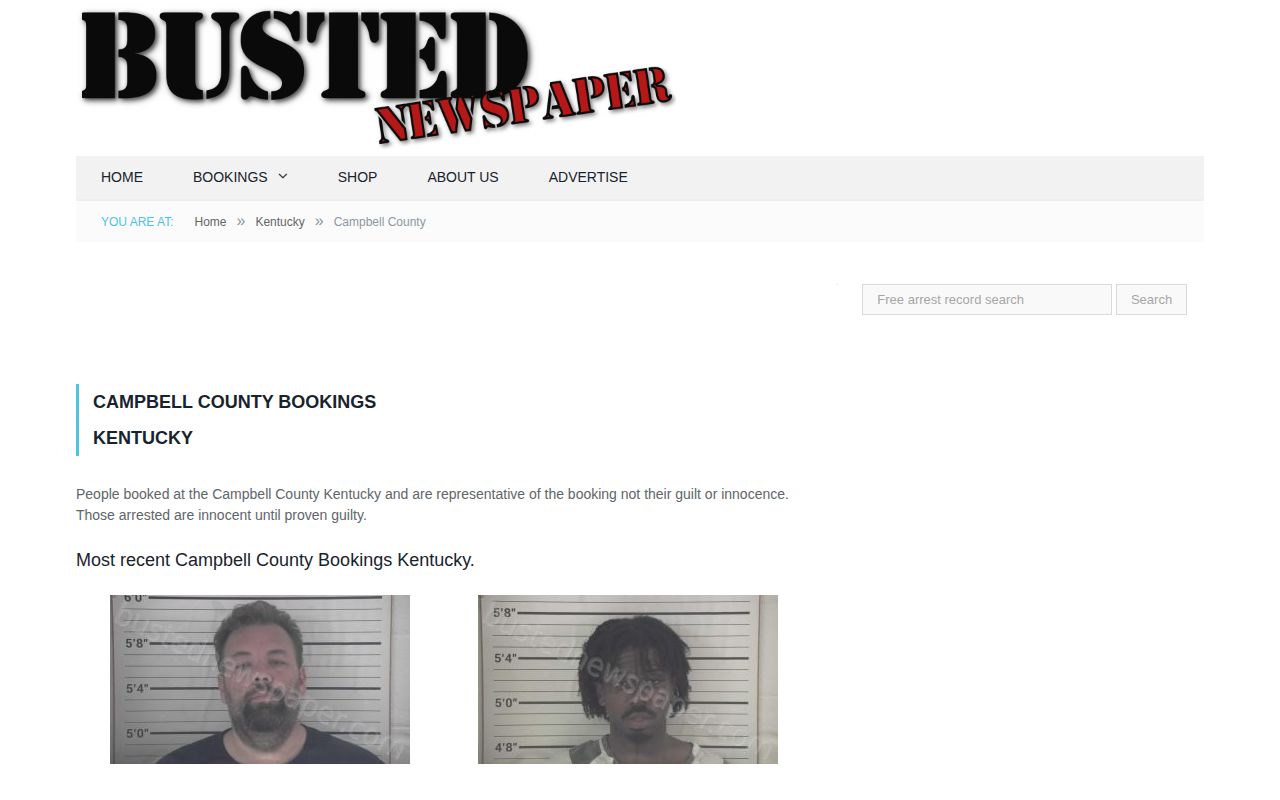
Older pages can document publication history. CCDC, the arresting agency, and the court remain the verification chain for any Campbell County arrest.
Campbell County Arrests by City
City police keep no jail rosters of their own. Each city holds its own incident-record route. Anyone booked into county custody appears at CCDC instead, which is why the department, the jailer, and the court each hold a different piece of a Campbell County arrest.
- Fort Thomas Recent Arrests: police publishes monthly and annual reports, not a daily booking list.
- Newport Recent Arrests: police records and CCDC bookings are distinct in the county seat.
- Alexandria Recent Arrests: police offers incident-report and dispatch-run requests, while JailTracker covers public county custody.
A city label on a third-party arrest page is just a lead. Confirm the arrest with that police department before you chase the report.
Campbell County Arrest Record Fields
The public roster shows a narrow slice of custody data. The full Campbell County booking file is broader. Not every field kept on paper is public or displayed online. Kentucky's jailer schedule covers admissions, releases, court orders, property, discipline, programs, photographs, incident reports, and court proceedings. Exemptions and redactions can still apply.
| Field | Meaning |
|---|---|
| Full name | Identity attached to intake |
| Booking date or number | Admission event, when releasable |
| Arresting agency | Office that may hold the incident report |
| Charges as booked | Accusations |
| Bond | Recorded pretrial release term |
| Booking photograph | Intake image, subject to law |
| Release or court data | Later events if maintained |
Released people can vanish from the Campbell County roster fast. The underlying arrest record stays put. The schedule places the jail register and inmate record file for destruction five years after release. That timeline is subject to holds and to the series actually maintained. Online visibility may lapse sooner. A private archive can persist well beyond any official copy.
Campbell Arrest Mugshots and Photos
JailTracker is where the official Campbell County booking photo path begins. The CCDC FAQ points the same way, noting that bond appears under the picture in a result. No rule guarantees a photo for every person. Released photos need not stay online. Images follow no set schedule either. When nothing appears, request that particular photograph from CCDC or the arresting agency. State inmates sit on a different track. Kentucky DOC's KOOL guidance says most state offenders have a photo, though not all, and an institutional image may take days after processing. It is not always the original booking photo. The official FAQ sets out the roster photo rule and its disclosure limits.
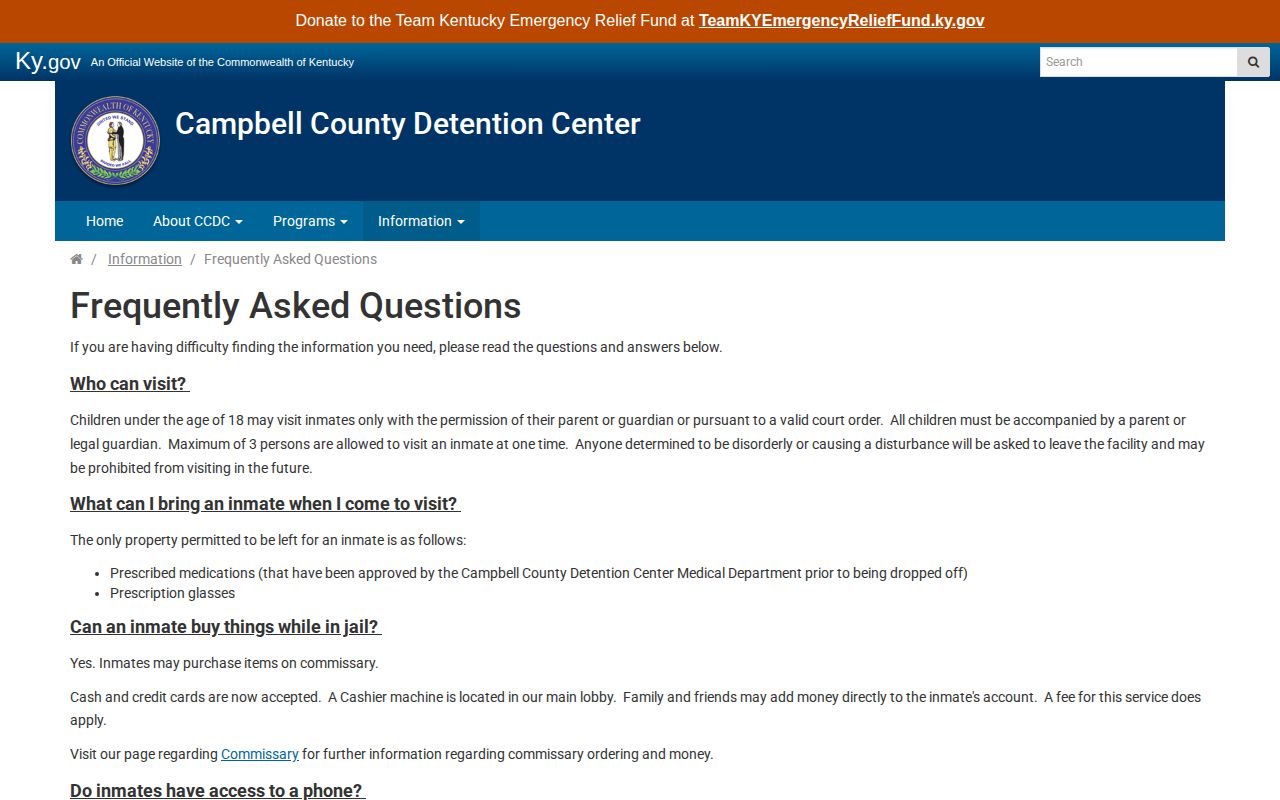
That policy is more reliable than assumptions based on another JailTracker deployment.
Request Campbell County Arrest Records
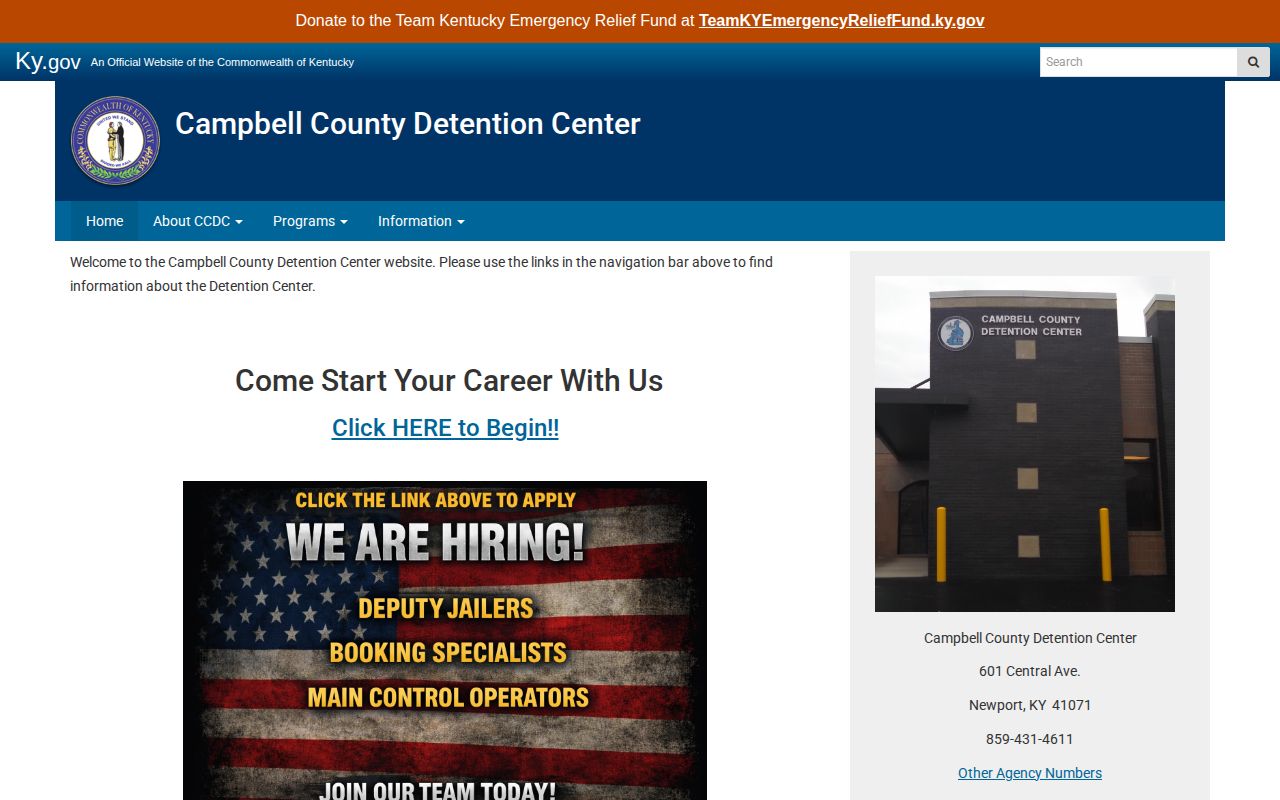
The CCDC open-records page tells requesters to send a signed request to CCDC, c/o Open Record Requests, 601 Central Ave., Newport, KY 41071. Hand delivery works, as do mail, fax at 859-431-5147, or email at openrecordsCCDC@campbellcountyky.gov. CCDC answers within five days, excluding weekends and legal holidays. That clock guarantees a response, not every item.
- Identify the person, approximate intake date, booking number if known, and arresting agency.
- Ask for the releasable booking record and photograph, if maintained, naming exact fields.
- Provide the Kentucky requester qualification and purpose details required by the form.
- Choose inspection or copies and ask for a cost estimate for unusual formats.
- Read any denial for its exemption, then ask which custodian holds a misrouted record.
An older 2023 CCDC PDF lists a different email from the live page. The current CCDC request page is the safer submission route. When timing matters, confirm the custodian at 859-431-4611. No separate CCDC photo fee is published. Fort Thomas charges 10 cents per written page plus actual cost for other media. Newport promises a five-business-day determination. Alexandria commonly quotes three to four business days for incident reports. Backlogs can add time.
Use the current contact information and retain the request and response.
Kentucky Arrest Photo Removal Law
Start with KRS §61.872, Kentucky's open-records foundation. Its companion, KRS §61.878, holds the exemptions. These cover privacy, investigations, protected law-enforcement information, and records closed by other law. A narrow request works best. Name a person, date, and agency rather than demanding every record. KRS §61.8746 governs commercial publication of public-agency booking photographs when removal is tied to payment or other consideration. It is an anti-pay-to-remove law with a Circuit Court remedy in qualifying cases. It is not a blanket erasure order.
Kentucky lets courts clear certain records. The Kentucky Courts expungement process hinges on the case outcome, the offense, the date, and overall eligibility. Court and KSP materials do not always agree on waiting periods, so verify the current rules with the county clerk or a lawyer. The courts' own expungement page lays out the court-centered path in full.
Search engines may refresh a result after a source changes. Delisting never edits the agency record itself. Busted Newspaper does document a free correction route for certain errors and outcomes. Comparable promises from other publishers are rare. Never pay an intermediary who guarantees erasure. Keep the URL, court order, request, and response on file.
Campbell County Arrest Warrants
Campbell County has no public warrant name-search. The sheriff's warrant instruction shares nothing by phone. A person must appear at the Sheriff's Office with photo ID, and a deputy runs the check. Kentucky eWarrants serves authorized personnel only. No most-wanted photo list or reward page exists. The county publishes no wanted count or schedule either. The county police tip voicemail at 859-547-3101 is not a warrant list and not for crimes in progress. Use 911 for emergencies, and never approach, follow, confront, or try to detain a wanted person. Anyone affected by a possible warrant should contact a lawyer or court and follow the sheriff's process.
After a Campbell County Arrest
Booking is only the start. The Campbell County Attorney describes arraignment as the first court step, where charges and rights are stated and a plea is entered. Kentucky sets no statutory arraignment deadline, per the Department of Public Advocacy. Timing depends on custody, docket, and case. Use Kentucky Judicial Indexes as a lead. The Campbell Circuit Court Clerk at 330 York St., Newport, 859-292-6314 holds the controlling file. Arrest, index, and indictment dates can all differ. Charges may be amended, dismissed, diverted, reduced, tried, or resolved by plea. The disposition records what happened after the arrest.
Campbell Arrests Beyond Local Custody
A Campbell County arrest can move past the local jail. For anyone tracing that, the Kentucky Offender Online Lookup is the practical next stop. KOOL tracks people held in state custody or under state supervision, not fresh county bookings. It filters by name, identifiers, status, location, conviction data, and projected dates. The system refreshes four times a day. Even so, records newer than 120 days may still lack final detail.
The Campbell County Detention Center holds some federal inmates. Yet its public search leaves out federal and immigration detainees. ICE lists CCDC as one of its detention sites. Its own locator handles current and recently released civil custody. Federal prison time falls to the BOP. The BOP offers no public mugshot gallery. A name missing from one system tells you nothing about the others.
| Stage | Best source |
|---|---|
| Fresh booking or local custody | CCDC JailTracker, then the jail |
| Released county record | CCDC and arresting agency request |
| Case outcome | Campbell Circuit Court Clerk |
| State sentence | Kentucky DOC KOOL |
| Federal or ICE custody | Responsible federal locator |
Note: Current custody, past booking, court disposition, and expungement are distinct record states and cannot be treated as the same thing. Check each separately.
Why Campbell Arrest Searches Miss
A name missing from a Campbell County arrest search can mean several things. The booking may still be in process. Bond may have been posted. A transfer to another facility is possible too. CCDC keeps federal and immigration detainees off its ordinary public inquiry. Misspelling trips up plenty of searches. No posting schedule or web-retention promise resolves any of that. Check the live roster, call the jail once the custody fact is known, and route federal questions to the right agency. A private page covering today or the last 30 days has its own refresh habits. It cannot fix an official roster miss.
Campbell Arrest News Versus Logs
News coverage and booking archives answer different questions for Campbell County arrests. LINK nky, NKyTribune, and WCPO pick the events that carry public weight, then build on them with reporting and follow-up from the courts. They skip most bookings. Private county archives sweep in far more names. But they add little context, and a month-old entry can sit unchanged long after the case has moved on. Neither source tells you who is behind bars right now. Check the date and the agency named, then turn to CCDC for current custody and the clerk for the outcome.
Which Campbell Arrests Stay Withheld
Public access has limits here. CCDC excludes federal and immigration detainees from its normal inquiry. Juvenile rules, sealed or expunged matters, privacy interests, and active-investigation exemptions can also block a response. Kentucky records law may allow release, redaction, delay, or withholding depending on the document itself. A denial never proves no arrest happened. Read the cited legal basis. Then figure out which office actually holds the record: CCDC, the arresting department, a court, the U.S. Marshals Service, or ICE.
Why Campbell Bookings Centralize
CCDC's structure explains a lot of confusion. In Kentucky, the elected jailer is separate from the sheriff. Yet the detention center takes bookings from police agencies across Campbell County. City police, county police, campus police, state police, and the sheriff can all show up as the arresting agency. CCDC keeps the booking record. The facility also houses state and federal populations. Not everyone held there is publicly searchable. Still, asking only the sheriff for a Campbell County arrest record can lead you to the wrong custodian.
Two Campbell Arrest Removal Paths
Kentucky offers two distinct removal paths, and they fix different problems. KRS §61.8746 targets commercial sites. These companies charge to take down a booking photo from a public agency. Expungement is a court process instead. Its availability depends on the charge, the outcome, the offense type, the date, and other rules. Neither path means instant internet deletion. Fix factual errors at the originating office first. For an eligible case, use the Circuit Court Clerk and official forms. Once a source corrects its record, work through a private publisher's documented free process. Then request a search-result refresh if needed.
Campbell Arrest Request Timing
Campbell County agencies share no single fee sheet or contact channel. CCDC publishes a five-day response statement but no separate booking-photo price. Fort Thomas charges per page on paper and actual cost for other media. Newport promises a determination within five business days. Alexandria gives ordinary incident-report timing and warns that backlogs add time. The record's creator controls the route. Ask CCDC for intake material, the police department for its incident file, and the clerk for the case. That beats blasting every office with one broad request.
Watch CCDC's contact discrepancy closely. Its current webpage and its 2023 PDF list different email addresses. Treat the current webpage as the lead source. Confirm the custodian by phone before any time-sensitive submission. That protects the request without inventing an address or assuming the older form is void.
Trace Older Campbell Arrest Records
When a name drops off the current roster, start with the arresting agency and CCDC. Give the person, date range, record type, and agency precisely. Then search the judicial index too. Ask the Campbell Circuit Court Clerk where the disposition sits. If an office says a record was transferred, request the records-series name, date span, and locator first. Then contact the Kentucky Department for Libraries and Archives or the State Records Center. Those repositories cannot replace a name search at the local clerk. Retention schedules list expected series. They also list retention periods. They do not prove every file was created, scanned, kept, or destroyed on schedule.